

Pradeep Khanal: A Religious and Diplomatic Personality Bridging Civilizations
In the contemporary landscape of South Asia—where religion, culture, and geopolitics continuously intersect—few individuals have attempted to harmonize spiritual devotion with diplomatic engagement as consistently as Pradeep Khanal. Emerging from Nepal, the sacred land of the Himalayas and the birthplace of Lord Buddha, Khanal represents a rare blend of pilgrim, organizer, cultural ambassador, and interfaith bridge-builder. His journey across sacred geographies and political corridors has shaped his identity as both a religious personality and a diplomatic connector in South Asia and beyond.
Spiritual Foundations in the Himalayan Civilization
Nepal has long stood at the crossroads of Hindu and Buddhist civilizations. From the sacred precincts of Pashupatinath Temple to the peaceful gardens of Lumbini, the country embodies a spiritual synthesis unique in the world. Growing up within this cultural environment, Pradeep Khanal was deeply influenced by Sanatan Dharma traditions while also embracing the broader ethos of interfaith respect that characterizes Nepalese society.
Unlike many who engage religion merely as ritual practice, Khanal undertook an extraordinary pilgrimage mission—visiting 52 Shakti Peeths, 12 Jyotirlingas, the Char Dham, major Sikh Gurudwaras, and significant Buddhist & Jain sacred sites across India, Nepal, Bangladesh, Sri Lanka, Pakistan, and Tibet (China). This spiritual undertaking is regarded by many observers as one of the most extensive pilgrimages of modern times.
In the spiritual narrative of Hinduism, references are often made to the unifying journeys of Adi Shankaracharya, who established monastic centers across India, and Guru Nanak Dev Ji, who traveled widely to promote universal brotherhood. In contemporary times, Khanal’s pilgrimage has been described by admirers as echoing that same integrative spirit—connecting sacred geography with civilizational dialogue.
Pilgrimage as Cultural Diplomacy
Pilgrimage, in Khanal’s vision, is not merely an act of personal devotion; it is a form of cultural diplomacy. By visiting sacred sites across political boundaries—including those in India, Pakistan, Bangladesh, Sri Lanka, Nepal, and Tibet—he demonstrated that faith traditions transcend modern nation-state divisions.
For example, performing rituals at Kashi Vishwanath Temple, seeking blessings at Kedarnath Temple, offering reverence at Nankana Sahib, and meditating in Bodh Gaya symbolize more than devotion. They signify a living connection between civilizations historically linked through shared spiritual heritage.
By engaging with priests, monks, and scholars in each location, Khanal contributed to strengthening people-to-people relations. In regions where political tensions sometimes overshadow cultural commonalities, such gestures reinforce the idea that shared spiritual traditions can serve as diplomatic bridges.
The Shiva Shakti Maha Samagam: A Vision of Unity
One of Khanal’s most ambitious undertakings is the organization of the Shiva Shakti Maha Samagam in Ujjain, India. Ujjain—one of the Sapta Puri (seven sacred cities of Hinduism)—has long been a spiritual epicenter associated with Mahakal and ancient astronomical knowledge.
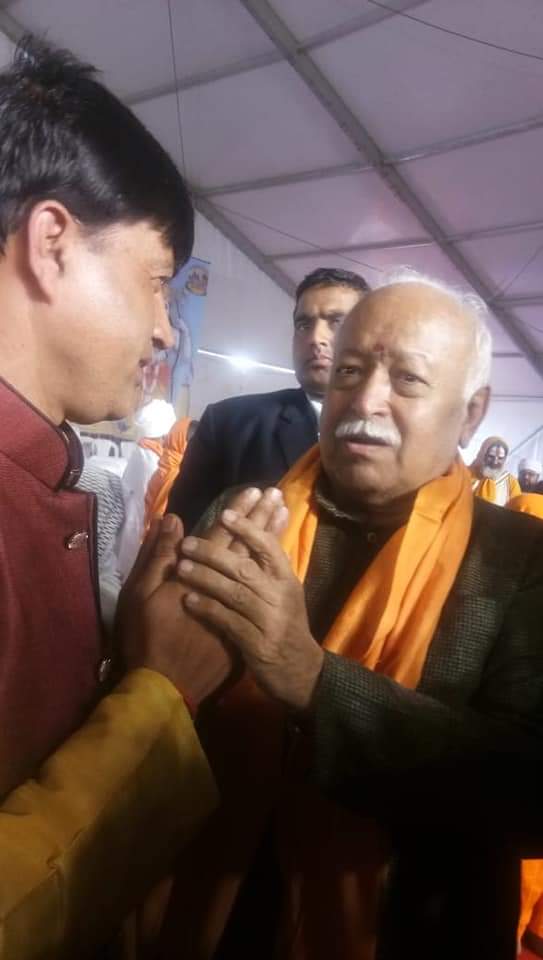
The proposed gathering aims to bring together Jagatguru Shankaracharyas, chief priests of Jyotirlingas and Shakti Peeths, Buddhist lamas, Sikh scholars, Jain representatives, and global spiritual leaders. The objectives extend beyond ritual observance. The event seeks to promote:
Interfaith harmony
Cultural diplomacy
Religious tourism
Preservation of Sanatan heritage
Regional cooperation among South Asian nations
In conceptualizing this Samagam, Khanal is positioning spirituality as a soft-power instrument—capable of fostering understanding among diverse religious communities and political systems.
Diplomatic Engagement at the Highest Levels
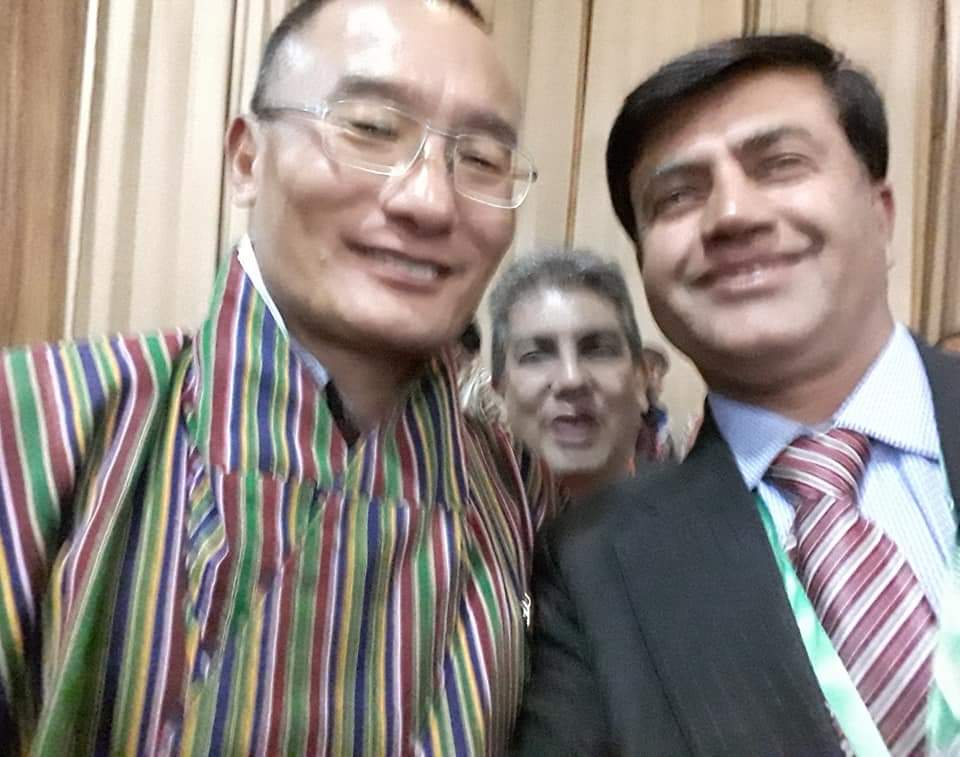
Khanal’s activities have not been confined to temples and monasteries. He has also engaged with heads of state, prime ministers, and parliamentary leaders across South Asia. His meetings have included interactions with figures such as:
Ram Chandra Paudel
H. D. Deve Gowda
Tshering Tobgay
These engagements have centered around cultural exchange, regional cooperation, and the role of spiritual diplomacy in strengthening South Asian unity.
In addition, Khanal has organized programs in the British Parliament focused on social issues and international relations, thereby extending his diplomatic outreach beyond South Asia. Such engagements demonstrate his belief that cultural heritage and faith-based dialogue can complement formal diplomatic frameworks.
Interfaith Harmony as a Core Principle
While rooted in Sanatan Dharma, Khanal’s work consistently reflects a broader inclusivity. His pilgrimage encompassed Sikh, Buddhist, and other sacred traditions, recognizing that South Asia’s civilizational identity is pluralistic.
For instance, visiting the Golden Temple in Amritsar and Nankana Sahib in Pakistan symbolizes respect for Sikh heritage, while meditation in Bodh Gaya honors the Buddhist path. These gestures reinforce the idea that spirituality need not divide; it can unite diverse traditions under shared ethical principles—compassion, truth, service, and harmony.
This approach aligns with the historical ethos of Nepal and the Himalayan region, where Hindu temples and Buddhist monasteries often coexist in close proximity, sharing rituals, festivals, and community life.
Cultural Tourism and Economic Vision
Beyond spiritual symbolism, Khanal recognizes the economic dimension of pilgrimage. Religious tourism constitutes a major sector in South Asia, attracting millions annually. By promoting structured pilgrimage circuits—linking Shakti Peeths, Jyotirlingas, Buddhist circuits, and Sikh heritage sites—he advocates for regional economic cooperation.
Such initiatives can generate employment, improve infrastructure, and enhance cross-border mobility. In this regard, Khanal’s vision intersects with broader developmental objectives, positioning religious heritage as a catalyst for sustainable growth.
South Asia’s Spiritual Soft Power
South Asia is home to some of the world’s oldest living spiritual traditions. Yet the region often struggles with political fragmentation. Khanal’s activities illustrate a counter-narrative: that shared spiritual heritage can serve as a foundation for unity.
His dialogue with SAARC representatives and political leaders indicates an awareness that people-to-people diplomacy often succeeds where formal negotiations falter. Faith-based cultural exchange can soften perceptions, build trust, and encourage collaboration on issues ranging from climate change to heritage conservation.
Author, Organizer, Cultural Integrator
In addition to his pilgrimage and diplomatic engagements, Khanal has embarked on literary and documentary projects aimed at documenting sacred sites and their historical significance. Through books and visual archives, he seeks to preserve and disseminate knowledge of South Asia’s spiritual geography.
Such documentation not only educates future generations but also strengthens civilizational continuity. In a rapidly globalizing world, cultural memory can easily fade; structured documentation ensures that sacred traditions remain accessible and relevant.
A Contemporary Model of Religious-Diplomatic Leadership
In assessing Pradeep Khanal’s profile, it becomes evident that his identity transcends conventional categories. He is not merely a pilgrim, nor solely a diplomatic activist. Rather, he represents a synthesis:
A religious seeker rooted in ritual, devotion, and spiritual discipline.
A cultural diplomat engaging leaders and institutions across borders.
A regional integrator promoting shared heritage among South Asian nations.
A documentarian and organizer preserving and promoting sacred traditions.
In an era often characterized by polarization—religious, political, and ideological—such integrative figures assume heightened importance.
Conclusion: Faith as a Bridge Between Nations
Pradeep Khanal’s journey illustrates how spirituality can transcend private devotion and evolve into public diplomacy. By linking temples, monasteries, parliaments, and international forums, he embodies a model of leadership grounded in faith yet oriented toward global dialogue.
From the banks of the Bagmati near Pashupatinath to the sacred ghats of Varanasi, from Himalayan monasteries to parliamentary chambers in Europe, his path reflects a consistent message: civilizations are strongest when they honor their spiritual roots while embracing cooperation.
As South Asia navigates the complexities of the 21st century, personalities who integrate religious devotion with diplomatic outreach may play a vital role in shaping a more harmonious regional future. In this context, Pradeep Khanal stands as a notable example of how faith, when guided by inclusivity and vision, can become a powerful instrument of unity and cultural diplomacy.









प्रतिक्रिया दिनुहोस्